
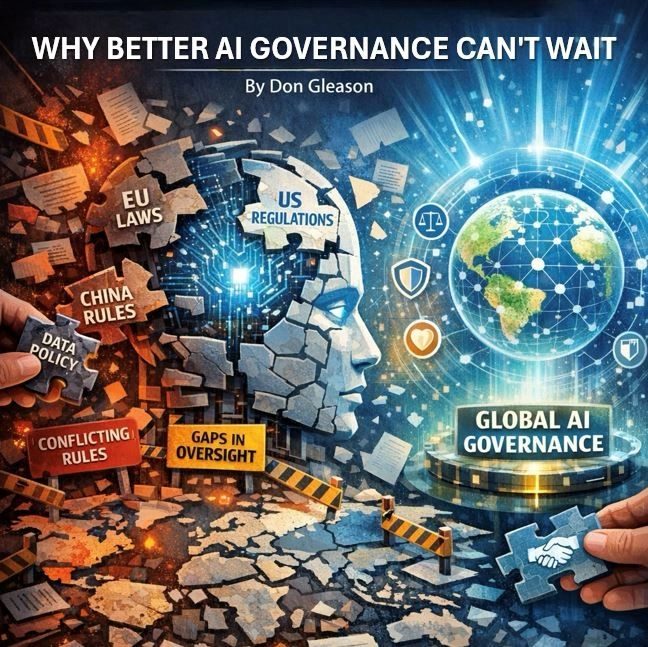
Why Better AI Governance Can't Wait
Don Gleason · · 7 min read
AI is advancing fast, but the rules meant to keep it in check are fragmented, inconsistent, and full of holes. If we want AI that's safe, fair, and worthy of public trust, we need a coordinated global approach — not a patchwork of half-measures.
Introduction
There is no question that artificial intelligence is reshaping how we live, work, and interact. From healthcare to hiring, from financial services to national security, AI is showing up everywhere — and doing so at a pace that most regulatory systems were not built to handle.
The problem is not that nobody is trying. Governments and international bodies worldwide have introduced policies, guidelines, and legislation to govern AI. But these efforts are uneven, often siloed, and riddled with gaps that leave real risks unaddressed. This article takes a close look at where current governance falls short and makes the case for a more comprehensive, globally coordinated approach.
1️⃣ Where Things Stand: A Fragmented Global Landscape
Region-Framework-Approach
- EU (AI Act): Comprehensive, risk-based with strict obligations for high-risk AI, transparency, and human oversight.
- US: Sectoral, fragmented due to voluntary guidelines, state-level laws, and industry self-regulation.
- UK: Principles-based, pro-innovation with contextual oversight, sectoral regulators.
- China: Centralized, state-led, with mandatory reviews, content control, and rapid legislative updates.
- OECD/UN: International principles that are non-binding, focus on transparency and accountability.
There has been meaningful progress, but these frameworks do not always play well together. The EU's rights-centered model, for instance, looks remarkably different from the US's hands-off, sector-by-sector approach. For companies operating across borders, this creates real confusion and compliance gaps.
2️⃣ The Gaps That Keep Us Up at Night
Fragmentation & Overlap
Let's start with the obvious: national laws rarely line up. That jurisdictional divergence doesn't just create legal headaches; it leaves entire populations with inconsistent protection.
On top of that, you've got multiple regulatory bodies operating in silos, each with overlapping mandates but limited coordination. The result? Diluted accountability and a lot of bureaucratic noise.
And then there's the definitional problem. When different countries can't even agree on what counts as "AI" or what qualifies as "high risk," loopholes are inevitable.
Ethical & Risk Coverage That Doesn't Go Far Enough
Most governance frameworks talk a good game about accountability & transparency. But talking about them and enforcing them are two vastly different things.
Algorithmic bias is a perfect example. Nearly everyone agrees it's a serious issue, yet operational guidance on how to detect and mitigate it in practice remains inconsistent at best.
And let’s not forget the emerging risks that regulators are still catching up to — things like generative AI misuse, deepfakes, and the growing autonomy of AI-driven weapons systems. These threats are evolving faster than the rules designed to contain them.
Enforcement That Lacks Teeth
Here's a recurring theme: too many frameworks are voluntary. When compliance is optional, noncompliance carries no real consequences.
Even where rules are mandatory, regulatory agencies are often under-resourced and lack the technical expertise to enforce complex AI requirements effectively.
Then there's the "black box" problem. When an AI system causes harm, figuring out who's responsible — and proving it — can be extraordinarily difficult.
Global Coordination That Isn't Happening
Without a unified international framework, cross-border AI operations and data flows remain dangerously under-governed.
Part of the challenge is that nations have competing interests. Strategic competition and differing political priorities make consensus hard to come by.
3️⃣ Ethics & Bias: Progress, But Not Enough
What's Actually Working
There are some bright spots. Transparency and explainability requirements are gaining real traction, particularly in the EU, and organizations like the OECD and NIST are pushing them as global norms.
Regular bias audits & impact assessments are becoming standard practice in forward-thinking organizations.
And there's growing recognition that the people most affected by AI — communities, workers, vulnerable populations — need a seat at the table when governance decisions are made.
What's Still Missing
The trouble is that many frameworks stop at principles and don't provide the practical tools teams need to detect and fix bias in real time.
Certain industries (e.g., finance and marketing) still lack the tailored ethical oversight their AI applications require. Without unified definitions and empowered regulators, even well-intentioned ethical guidelines end up applied unevenly.
4️⃣ Risk Management & Accountability: Falling Short Where It Matters
Liability & Audits
The EU is arguably the furthest ahead here, with proportional liability rules and mandatory audits for high-risk AI systems.
The US, by contrast, still relies heavily on traditional liability doctrines — frameworks not designed for autonomous systems that leave significant "responsibility gaps" when AI acts on its own.
Audit requirements? They vary wildly from one jurisdiction to the next, with no global standard in sight yet.
Incident Response & Enforcement
There's currently no universal protocol for reporting or responding to AI-related incidents. When things go wrong, victims often can't access the information they need to prove what happened or hold anyone accountable.
That's a serious problem — and one that will only grow as AI becomes more autonomous.
5️⃣ What Comprehensive AI Governance Should Look Like
The Core Insight:
Effective AI governance needs to be global in scope, enforceable in practice, adaptive by design, and grounded in ethical principles. It has to cover the full AI lifecycle — from the earliest stages of design through deployment and beyond — with clear accountability at every step.
The 5 Essential Pillars of AI Governance
Pillar 1 - Global Coordination & Harmonization
International standards and treaties are the foundation. Without them, we're left with a maze of conflicting rules that protect some people and leave others exposed.
Pillar 2 - Lifecycle Risk Management
Risk assessments, audits, and incident response plans shouldn't be afterthoughts. They need to be baked into every stage of the AI lifecycle — from concept through retirement.
Pillar 3 - Ethical & Fair AI by Default
Bias mitigation, transparency, and meaningful stakeholder engagement can't be optional extras. They need to be core requirements with real enforcement behind them.
Pillar 4 - Clear Accountability Structures
Liability should follow control. Those best positioned to prevent harm should bear responsibility for it — backed by independent audits and certifications.
Pillar 5 - Dynamic, Adaptive Regulation
AI doesn't stand still, and neither can the rules that govern it. Regulatory frameworks must be designed to evolve as the technology — and the risks — continue to change.
SO, What Does This Mean?
Here's the honest truth: AI holds enormous promise, but that promise rings hollow if the systems governing it aren't up to the task. Right now, they're not. The frameworks we have are a start — but they're too fragmented, too inconsistent, and too often unenforceable to protect people from real harm.
Getting this right won't be easy. It requires political will, technical expertise, and genuine international cooperation. But the stakes for individuals, organizations, societies, and the technology's trajectory are too high to settle for anything less than comprehensive, adaptive, and enforceable governance.
The time to act isn't someday, it's now!
- Today's governance frameworks are fragmented and unevenly enforced, undermining trust and safety.
- Ethical oversight and bias mitigation are improving, but still lack the practical teeth to make a consistent difference.
- Clear accountability and global coordination aren't luxuries — they're necessities.
- Building comprehensive, adaptive, and enforceable frameworks is the single most important step we can take to ensure AI works for everyone.
Discover how DGCpartners can empower your team with sustainable, technology-agnostic solutions for long-term success by visiting DGCpartners today!
References
“Artificial intelligence, complexity, and systemic resilience in global governance” by Andrés Ilcic, Miguel Fuentes, and Diego Lawler, 2025 https://www.frontiersin.org/journals/artificial-intelligence/articles/10.3389/frai.2025.1562095/
“AI Governance in a Complex and Rapidly Changing Regulatory Landscape: A Global Perspective” by Esmat Zaidan & Imad Antoine Ibrahim, 2024 https://www.nature.com/articles/s41599-024-03560-x
“AI governance: a systematic literature review” by A. Batool, D. Zowghi, & M. Bano, M. AI Ethics 5, 3265–3279 (2025) https://link.springer.com/article/10.1007/s43681-024-00653-w
“The anatomy of AI policies: a systematic comparative analysis of AI policies across the globe” by Amna Batool, Sunny Lee, Yue Liu & Liming Dong, 2025 https://link.springer.com/article/10.1007/s43681-025-00886-3
“AI, Machine Learning & Big Data Laws and Regulations 2025 - Autonomous AI: who is responsible when AI acts autonomously and things go wrong?” by Erica Stanford (GLI: Global Legal Insights), 2025 https://www.globallegalinsights.com/practice-areas/ai-machine-learning-and-big-data-laws-and-regulations/autonomous-ai-who-is-responsible-when-ai-acts-autonomously-and-things-go-wrong/
“Navigating the AI regulatory landscape: Balancing innovation, ethics, and global governance” by Guido Perboli, Nadia Simionato, & Serena Pratali, 2025 https://www.tandfonline.com/doi/full/10.1080/20954816.2025.2569584
“Transparency and accountability in AI systems: safeguarding wellbeing in the age of algorithmic decision-making” by Ben Chester Cheong, 2024 https://www.frontiersin.org/journals/human-dynamics/articles/10.3389/fhumd.2024.1421273/full
Ethical theories, governance models, and strategic frameworks for responsible AI adoption and organizational success by Mitra Madanchian and Hamed Taherdoost, Frontiers in Artificial Intelligence, 2025 https://pmc.ncbi.nlm.nih.gov/articles/PMC12307427/
“AI Governance Overview: Understanding Regulatory Requirements Across Global Jurisdictions” by Mariia Kyrychenko, Mykyta Mudryi, and Markiyan Chaklosh - ARIMLABS.AI, 2025 https://arxiv.org/html/2512.02046v1
“Earned Trust Through AI System Assurance”, National Telecommunications and Information Administration - NTIA, 2024 https://www.ntia.gov/issues/artificial-intelligence/ai-accountability-policy-report/using-accountability-inputs/liability-rules-and-standards
“AI Watch: Global regulatory tracker - United States” White & Case, 24 September 2025 https://www.whitecase.com/insight-our-thinking/ai-watch-global-regulatory-tracker-united-states