
Impact of Deportations on U.S. Biz: Labor Shortages & Job Losses
Don Gleason · · 6 min read
The NYTimes recently reported that over 668,000 jobs have been lost in the U.S. in the past year due to deportation-driven labor shortages, with the most severe impacts in agriculture, construction, hospitality, and manufacturing.
In addition, tens of thousands of businesses have been negatively affected (with many crippled, forced to reduce operations, or permanently closed) because they cannot find adequate labor to replace deported workers.
Most affected businesses report ongoing hiring difficulties, increased costs, and lost revenue, underscoring the critical role of immigrant labor in key sectors.
A substantial number of U.S. businesses (especially in agriculture, construction, hospitality, and manufacturing) have been negatively affected or crippled by deportations and the resulting inability to find adequate labor, as shown by the reported loss of over 668,000 jobs in the past year. While precise national figures for permanent business closures directly attributed to deportations are not available, industry surveys and economic reports confirm that at least 1 in 5 businesses have lost employees due to deportations, with 12% of small businesses shutting down locations (temporarily or permanently) and 72% reducing operations or hours due to labor shortages. The inability to replace deported workers with domestic labor is a consistent theme across all major affected industries.
1️⃣ The 668,000+ Job Loss Statistic: Source & Credibility
Origin: The figure of over 668,000 jobs lost is based on economic modeling by the American Immigration Council and the National Bureau of Economic Research (NBER), reported by The New York Times, which estimates that for every 1M undocumented immigrants deported, approximately 88,000 U.S. citizens and legal residents lose their jobs due to economic contraction and business closures
Supporting Data: Bureau of Labor Statistics (BLS) employment trends in sectors like agriculture, hospitality, and construction show significant declines that align with intensified deportation actions
Timeline: The majority of these job losses occurred from mid-2025 to mid-2026, coinciding with a surge in enforcement and deportations
2️⃣ Cross-Industry Business Impact: Closures, Reduced Operations, and Financial Losses
Clarify Capital suggests that:
Businesses losing employees: 1 in 5 business owners reported losing employees due to deportations or ICE raids
Permanent/temporary closures: 12% of small business owners reported shutting down locations due to hiring challenges
Reduced operations/hours: 72% of small business owners have reduced hours, shut locations, or delayed expansion
Financial burden: Avg. $11,908 per affected business for hiring/training/lost productivity
Wage increases: 69% of businesses raised wages; 1 in 8 increased wages by >20%
Lost customers: 69% of small businesses lost customers due to immigration crackdowns
Increased staff burnout: 86% report increased workloads or burnout among remaining staff
The ripple effects of deportations extend far beyond direct job losses, causing widespread operational disruptions, increased costs, and lost revenue for tens of thousands of businesses.
3️⃣ Industry-by-Industry Breakdown
🚜 Agriculture (visaverge reports)
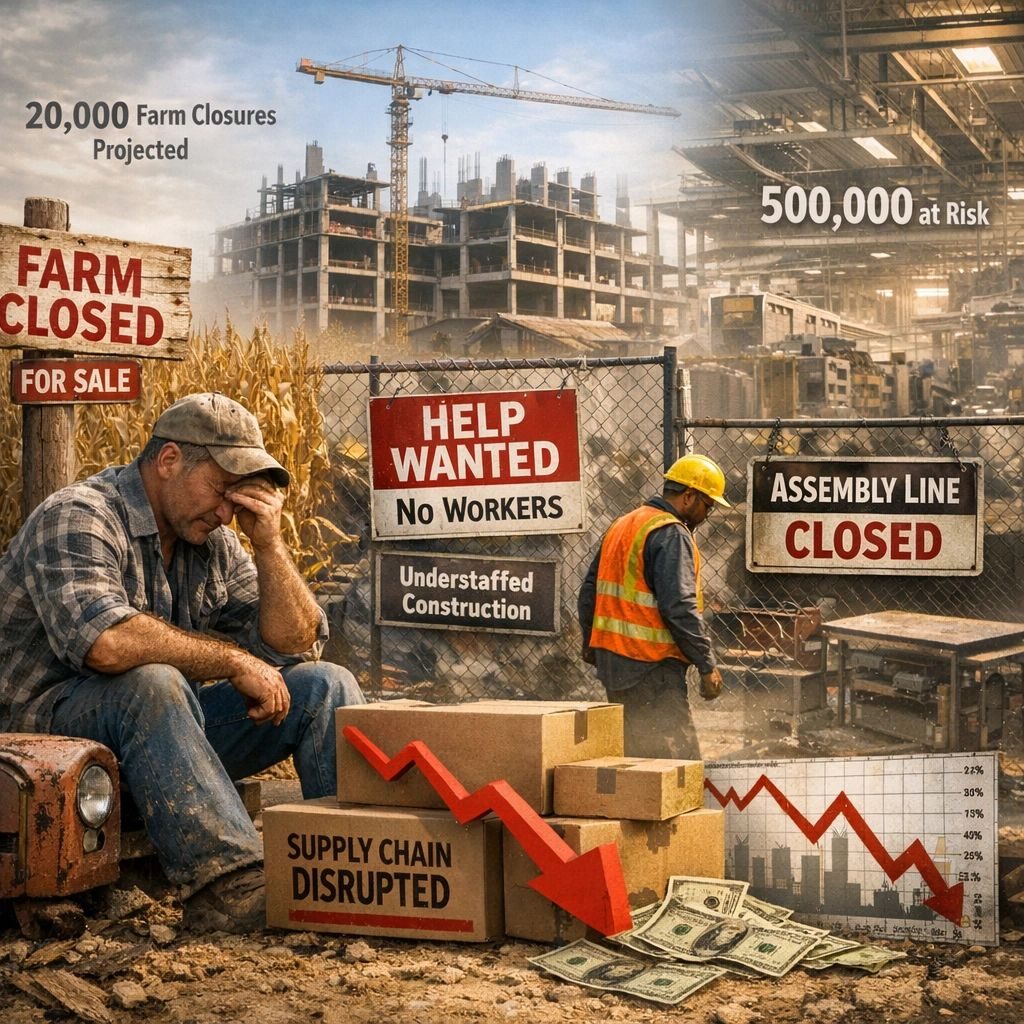
Farm Closures: 20,000 projected closures in 2026 alone, with small family farms most affected
Crop Losses: Up to 30–40% in key regions (e.g., $5–7B in California, 25% yield drop in Florida)
Labor Shortages: 70% of dairy labor needs unmet; H-2A visa delays widespread
Replacement Difficulties: The majority of affected farms cannot fill positions with domestic labor due to high costs and visa backlogs
"Farmers are facing a crisis of labor availability that threatens the viability of entire operations." ~ John Walt Boatright, American Farm Bureau Federation
🚧 Construction
Labor Shortages: 92% of firms report difficulty hiring; 88% have craft worker openings (agc.org)
Project Delays: 45% of firms report project delays due to labor shortages (agc.org)
Direct Impact: 28% of firms are directly affected by immigration enforcement (enr.com)
Replacement Difficulties: Most contractors are unable to fill positions with domestic labor; only 10% use temporary visa programs (agc.org and uschamber.com)
"The construction industry is being squeezed by a shrinking labor pool, and immigration enforcement is making it worse." ~Stephen E. Sandherr, AGC CEO
🍽️ Hospitality & Food Service
Civileats (civileats.com) reports that:
Closures/Reduced Hours: Widespread restaurant closures and reduced hours in high-enforcement regions
Staff Shortages: Many businesses unable to replace deported workers with domestic labor
Replacement Difficulties: Domestic recruitment efforts have not filled the gap left by deportations
"It's affecting the economy of the whole country and people who used to pay taxes and contribute to the economy now are in deportation centers." ~ Alexandra Sossa, CEO, Farmworker and Landscaper Advocacy Project
🏭 Manufacturing & Meatpacking
Jobs at Risk: Up to 500,000 ag-related jobs (packing, transport, local businesses) at risk
Plant Slowdowns/Shutdowns: Widespread in affected regions due to inability to replace deported workers
Replacement Difficulties: Most plants are unable to fill positions with domestic labor; visa program backlogs persist
Without a balance between enforcement and legal labor pathways, farm numbers could be cut in half by 2030, with downstream effects on food processing and manufacturing." ~ visaverge.com
4️⃣ Data Limitations & Context
Exact Numbers: While survey data & industry reports provide compelling evidence of widespread business impact, precise national figures for permanent closures directly attributable to deportations are either unavailable or obscured by overlapping causes (e.g., economic trends, automation, policy changes, or politicalization).
Consistent Theme: Across all major sectors, the inability to replace deported workers with domestic labor is a persistent & well-documented challenge.
🌟 Deportation-driven labor shortages are causing widespread disruption across U.S. industries, threatening both businesses and the broader economy. These actions have crippled tens of thousands of U.S. businesses, especially in agriculture, construction, hospitality, and manufacturing. The reported loss of over 668,000 jobs is matched by widespread business closures, reduced operations, and financial strain. Most affected businesses have been unable to find adequate domestic replacements, highlighting the essential role of immigrant labor in sustaining the American economy.
The data is clear and the consequences are undeniable: deportation-driven labor shortages have rippled across every pillar of the U.S. economy, costing more than 668,000 jobs in a single year, forcing 72% of affected small businesses to reduce hours or operations, and pushing 12% to shut down locations entirely — while agriculture, construction, hospitality, and manufacturing each face crises they cannot solve by turning to domestic labor alone. With 20,000 farm closures projected in 2026, 92% of construction firms struggling to hire, and up to 500,000 ag & manufacturing jobs at risk, the window for course correction is narrowing fast. Policymakers, business leaders, and industry advocates must urgently work together to develop balanced solutions — ones that pair responsible enforcement with expanded, streamlined legal labor pathways — to protect American jobs, businesses, and the supply chains that communities depend on every day. The evidence may have its limits in precision. Still, the direction it points is unmistakable: a sustainable immigration and labor policy is not just a humanitarian imperative — it is an economic one.
About
Don Gleason leads a consulting practice focused on business & technology transformations. The kind of transformations where there is a lot at stake, lots of moving parts, and usually where something had already gone sideways (and needed him to get it back on track & done. Over the past 25 years, Don led those efforts for organizations like GD/BIW, IBM, UnitedHealth, and numerous Blue Cross Blue Shield plans and health systems, typically managing teams of 50 to 200-plus people across complex programs.
What I know Don does differently is stay close to execution and be a 'people-first' leader. He is not the person who hands you a strategy deck and disappears.
DGCpartners is a hands-on independent mgmt & technology consulting firm offering CXO advisory, strategic program management, and BCP services. DGCpartners brings expertise to make a critical difference in Business-IT turnarounds, strategic programs/projects – in government (health & tech), manufacturing, retail, oil & gas refining, healthcare, laboratory, & insurance. We have honed our skills at rescuing initiatives that are struggling to make progress and deliver needed outcomes.
Supporting domestic (N.America) & international clients (UK, UAE, Pakistan, Brasil)
DGCpartners enables Implementations & Transformations (BTOs/PMOs), driving complex initiatives across the enterprise to execute the strategic goals & vision of the organization | Building your in-house competency by ensuring the methods, tools, tips & techniques [ SYNC - ASSESS - STRATEGIZE - SELECTION - CONFIGURE - TEST - TRAIN & TRANSITION - IMPLEMENT - OPTIMIZE ]