

Project & Task Prioritization Framework for IT Governance
Don Gleason · · 5 min read
Governance Prioritization Framework
The following is a governance prioritization framework we use in ranking priorities within an organization. The scoring rubric varies by the type of organization and its strategic priorities. This example framework integrates the latest best practices (2022–2026) from our experience and the leading research in business and IT governance, providing a practical, multi-criteria, and transparent approach for medium-sized governance teams (5–15 members) to prioritize programs, projects, and tasks. It balances risk management, strategic alignment, resource optimization, and stakeholder engagement for robust, agile, and accountable decision-making.
Introduction & Guiding Principles
Purpose: To enable governance teams to systematically prioritize projects and tasks, ensuring alignment with organizational goals, effective risk management, optimal resource use, and transparent stakeholder engagement.
Guiding Principles:
- Strategic Alignment: Prioritize work that advances organizational OKRs/KPIs.
- Risk & Compliance: Address regulatory, security, and operational risks proactively.
- Resource Optimization: Maximize impact with available team capacity.
- Transparency & Engagement: Foster trust through open communication and collaborative decision-making.
Multi-Criteria Weighted Scoring Model
Scoring Criteria & Weights
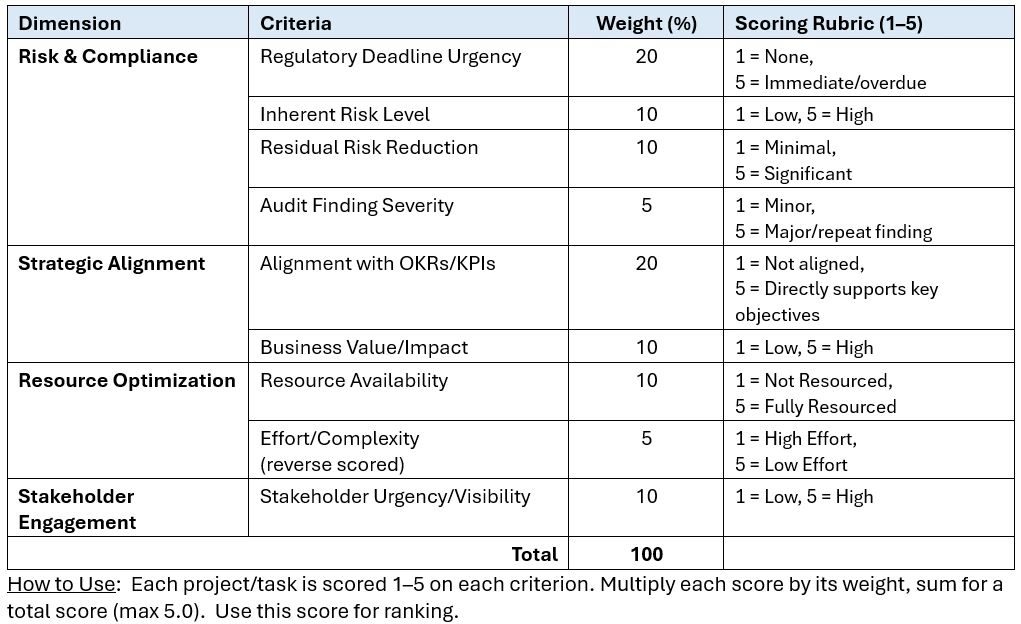
Prioritization Methodologies
- Value vs. Risk Matrix: Visualize projects by plotting business value against risk to identify high-value, low-risk priorities.
- MoSCoW Categorization: Assign each item as Must, Should, Could, or Won't (this cycle) based on score and criticality.
- WSJF (Weighted Shortest Job First): For rapid value delivery, prioritize by dividing value (cost of delay) by effort.
- OKR-Aligned Scoring: Ensure top priorities directly advance current OKRs/KPIs.
- Visual Portfolio Kanban/Hopper: Use a digital board to map, track, and reprioritize all projects/tasks collaboratively.
Step-by-Step Prioritization Process
A. Intake
- Collect project/task proposals via a standardized intake form.
- Ensure each submission includes the required information for scoring.
B. Scoring
- Assign at least two team members to independently score each item using the weighted scorecard.
- Average scores for objectivity.
C. Review
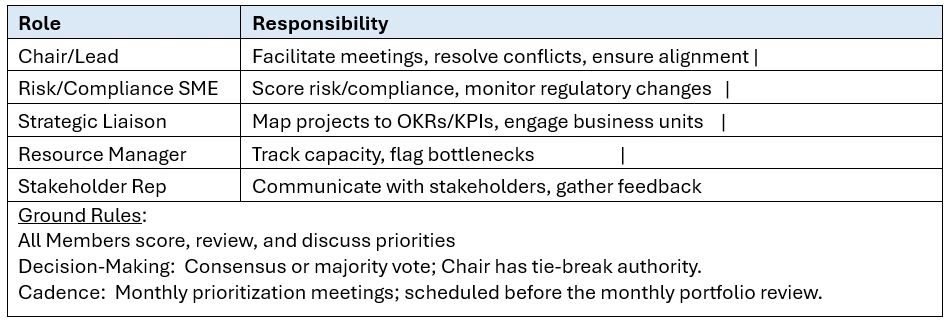
- The Governance team meets monthly to review scores, discuss outliers, and finalize prioritization.
- Use the Value vs. Risk Matrix and MoSCoW to categorize and visualize.
D. Execution
- Assign resources based on priority, capacity, and dependencies.
- Track progress on a Kanban board.
E. Reprioritization
- Monthly (or as needed), review portfolio for new risks, shifting business needs, or resource changes.
- Adjust scores and priorities accordingly.
Governance Cadence & Decision-Making Structure
Stakeholder Communication & Transparency
- Decision Logs: Maintain a digital log of all prioritization decisions and rationales.
- Portfolio Dashboards: Use real-time dashboards (e.g., in Jira, Trello, or MS Planner) to improve visibility.
- Differentiated Reporting:
- Executives: High-level summaries, strategic alignment, risk posture.
- Team Members: Detailed task status, resource allocation.
- Business Units: Impact on their objectives and timelines.
Resource Optimization & Capacity Planning
- Capacity Tracking: Use workload management tools to monitor team bandwidth.
- Scenario Planning: Run "what-if" analyses for major new initiatives.
- Bottleneck Management: Flag and escalate resource constraints early.
- Role Rotation: Cross-train team members to increase flexibility.
Ready-to-Use Scoring Scorecard

Implementation Guidance & Success Metrics
Implementation Steps:
- Train the team on scoring and tools.
- Pilot the framework on a subset of projects.
- Refine weights/criteria as needed after initial cycles.
- Roll-out to all governance activities.
Success Metrics:
- % of high-risk / compliance tasks completed on time
- Stakeholder satisfaction (survey)
- Alignment of completed projects with OKRs/KPIs
- Reduction in resource bottlenecks
- Transparency (number of decision log entries, dashboard usage)
This sample framework empowers governance teams to make transparent, data-driven, and strategically aligned prioritization decisions by balancing risk, value, resources, and stakeholder needs for maximum organizational impact. As mentioned previously, this example is one of several we consider in light of a client's unique circumstances.
Adaptations: Quantitative vs. Qualitative vs. Blended Scoring - When and Why
Quantitative scoring (e.g., assigning numerical weights and scores) is highly effective in situations where objectivity and standardization are essential. It helps reduce bias by grounding decisions in measurable criteria and makes it easier to rank and compare projects or tasks. In addition, it ensures consistency across different assessors and time periods and allows stakeholders to see how decisions are based on clear numbers. Quantitative scoring is best for situations where you need data-driven decisions (e.g., balancing risk vs. business value). It is beneficial for high-complexity portfolios where subjective judgment alone could lead to inconsistencies, and when you want to create a decision audit trail for accountability (e.g., regulatory compliance).
Qualitative Scoring (e.g., subjective assessments or descriptive evaluations) is best for addressing nuanced, context-driven considerations that numbers can't fully capture. It provides flexibility in allowing teams to account for unique, unquantifiable factors (e.g., stakeholder sentiment or political context). In addition, it captures the "why" behind decisions that numbers alone might miss and works well when quantitative data is unavailable or incomplete. Qualitative scoring is best for situations where subjective judgment is critical (e.g., stakeholder expectations or team morale), especially for early-stage projects/tasks where criteria like effort or value are difficult to quantify, and when human factors play a significant role (e.g., assessing stakeholder urgency or buy-in).
Blended Scoring Approach (hybrid scoring approach) leverages the strengths of both systems to create a more holistic prioritization process. In practice, it typically uses quantitative scoring as the baseline (e.g., weighted criteria for risk, value, etc.). It supplements it with qualitative discussion during review meetings to incorporate context, nuance, or unforeseen factors. It allows exceptions (factoring) to quantitative rankings based on qualitative input. It requires strict adherence to the rationale documentation (e.g., "This project scored low, but we're fast-tracking it due to the CEO mandate."). The ranking process includes multiple stages: teams independently score projects quantitatively, then formally discuss qualitative factors such as stakeholder politics, team morale, or external trends, combining quantitative rankings with qualitative insights to finalize prioritization.
We often recommend a blended quantitative-qualitative approach, since it balances the need for objective prioritization (to justify decisions to stakeholders) with flexibility (to adapt to shifting organizational dynamics). This approach ensures that critical but hard-to-quantify factors are not overlooked. In essence, quantitative scoring provides structure, while qualitative input adds depth and adaptability. Combining both creates a robust, agile prioritization process that ensures decisions are both data-driven and contextually informed.
DGCpartners LLC is a business & technology transformation consulting firm helping clients recover struggling programs & projects – assessing, remediating, mentoring, and coaching organizations in the critical aspects of people, process, technology, and culture.
REACH OUT to us at info@dgcpartners.com, visit us at DGCpartners.com ( https://www.dgcpartners.com ), or on LinkedIn ( https://www.LinkedIn.com/company/DGCpartnersLLC )
Discover how DGCpartners can empower your business with technology-agnostic consulting and sustainable change strategies for long-term success!