

How SMBusinesses Can Use AI to Improve Data Insights & Decisions
DGCpartners · · 6 min read
For local business owners, service providers, and small online sellers, business data analysis often is just reports, spreadsheets, and dashboards that still fail to answer simple questions. Decisions need to be quick and confident, yet numbers can feel messy or too time-consuming to interpret. A beginner-friendly introduction to AI helps small business owners understand the basics and use it as a practical tool for pattern-spotting and better decision-making. With the right mindset, AI-driven data optimization becomes an accessible business skill.
Understanding the Skills Behind AI Insights
Think of AI as a practical toolkit, not a mystery. Learn a few artificial intelligence fundamentals, since artificial intelligence (AI) means computers performing tasks that usually need human thinking, and connect to simple machine learning concepts. Next, build the basics: data literacy, introductory statistics, basic programming, and data governance.
AI does not fix messy inputs or unclear goals. When you can read your numbers, ask better questions, and set rules for your data, AI outputs become easier to trust and act on. Learning becomes a step-by-step path, and a structured option like an IT bachelor's degree can fit into that progression.
Picture a cafe owner tracking sales, staffing, and promotions. With data literacy and basic statistics, they can spot what’s standard, what's a spike, and what's noise. Add basic governance and ensure the team uses a consistent definition of "returning customer."
With these foundations, you can try practical AI automation and data-quality upgrades with far less risk.
Apply 7 Quick Wins for AI-Driven Data Processing
You do not need a massive overhaul to get value from AI-driven data processing. Start with small, low-risk experiments that strengthen your data literacy and governance basics, enabling faster, clearer decisions.
- Pick one decision and define success: Choose a weekly decision (reorder inventory, schedule staff, prioritize leads) and write 2–3 success metrics it should improve. This keeps business intelligence automation focused on outcomes rather than dashboards. If your team is new to stats, keep it simple: one primary KPI, one supporting metric, and a clear time window, such as "the next 30 days."
- Do a 30-minute data check before AI: Pull 20 recent rows from your data and check for missing values, inconsistent categories, duplicates, and outdated fields. Fix the easiest issues first, with a short 'data dictionary' that defines each column and its allowed values. This is data governance in action. Many teams get stuck here; data quality problems for AI are common.
- Automate one repetitive report using plain-language Q&A: Find a weekly report (sales by channel, returns, cash flow) and set up a process for a chat-style assistant to summarize key changes, anomalies, and 'what moved most.' This practicality reduces formatting time and increases interpretation time. Some teams use AI chatbots with analytics platforms to answer data questions in plain language and provide quick summaries.
- Set up" input rules" at the source to prevent messy data: Instead of cleaning after the fact, add simple constraints where data is created, required fields, dropdown categories, consistent date formats, and basic validation checks. This single step often delivers the fastest data-quality improvement by preventing problems from multiplying. "If multiple people are entering data, assign one owner to review exceptions twice a week for 10 minutes each time.
- Start with assistive machine learning, not opaque predictions: Use ML to support judgment—cluster customers, flag unusual transactions, or estimate demand, rather than replace decisions. These beginner tasks are easier to test and explain, aligning with early-stage statistics skills. Require each result to provide a readable reason, such as "outlier due to spike in quantity."
- Create a small experiment loop for analytics: Run a 2-week cycle: form a hypothesis, test on a small sample, review results, and decide to keep, kill, or adjust. For example, "If we forecast weekly demand using the last 8 weeks, stockouts will drop," then compare the forecast to the actual. Keep a log of assumptions and changes to speed up your learning.
- Add guardrails: Access, privacy, and a rollback plan. Decide who can view sensitive fields, how long you retain data, and what happens if an automated insight is wrong. A practical rule is: "humans approve anything that affects pricing, credit, or staffing" until performance stabilizes. These guardrails turn AI into a sustainable habit; one you can trust during busy weeks.
These small wins lead to clearer data, more reliable AI outputs, and a repeatable process for smart decisions. Focus on clean data, simple automations, and practical experiments as key takeaways to keep progress steady.
Plan → Prepare → Test → Integrate/Ship → Learn
To make this sustainable, use a weekly rhythm.
This workflow turns AI from an experiment into a dependable habit: choose one business question, prepare inputs, test safely, then incorporate what you learn into operations. Consistency separates useful insights from "random acts of analytics," especially since 95% of AI projects fail to deliver outcomes.
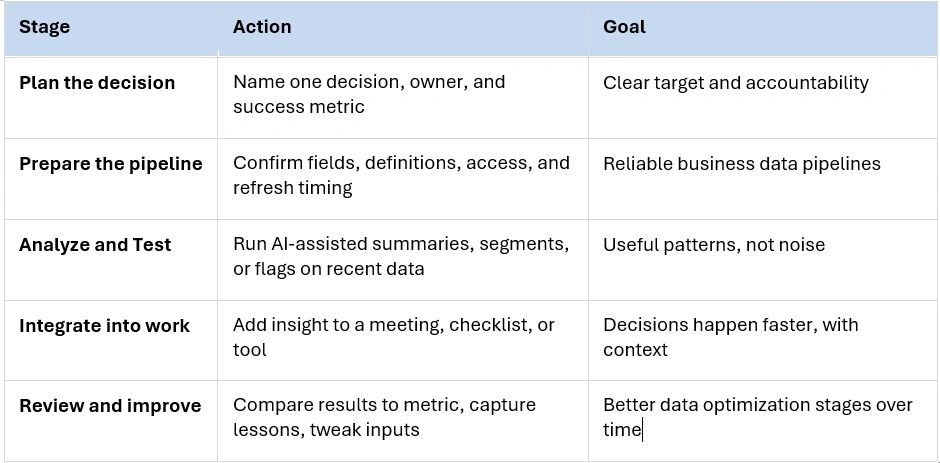
Each step hands off cleanly, keeping machine learning integration explainable and repeatable. Treat it as an AI project lifecycle so improvements compound without consuming more hours.
Start small, run the experiment loop once, and let your results grow trust and confidence. The main takeaway: steady progress with clear checks is more effective than big leaps.
AI for Better Decisions: Questions Small Businesses Ask
When you hit real data, the questions get practical fast.
Q: What if I do not have "big data,” only spreadsheets and a POS export?
A: That is enough to start. Pick one decision, such as staffing, reorders, or lead follow-up, then use a clean table with clear dates, amounts, and categories. AI helps most when the question is narrow and the fields are consistent.
Q: How can I use AI without exposing customer or payroll data?
A: Begin with the minimum data needed and remove names, emails, and exact addresses before you upload anything. Use role-based access controls, enable multi-factor authentication, and maintain an internal " approved tools” list, as 93% of security leaders anticipate daily AI attacks. When possible, test insights on a sample dataset first.
Q: Why does AI sometimes give different answers to the same question?
A: Small prompt tweaks and shifting context can alter answers, especially in chat tools. Stabilize results with a prompt template, fixed date range, and consistent metric definitions. If variance persists, ask for the assumptions and have the tool display the calculations or logic.
Q: What does "responsible AI" mean for a small business?
A: It means using tools in a way that protects people and keeps decisions explainable. A helpful guide is that responsible AI prioritizes ethical safeguards to reduce bias, improve transparency, and support compliance. Translate that into simple rules, such as human review for high-impact decisions and a straightforward way to appeal mistakes.
Q: How do I troubleshoot messy insights that do not match what I see in the business?
A: Treat it like a data quality check before you blame the model. Look for duplicates, missing dates, mixed currencies, or changing category names, then rerun the analysis with fewer columns and a shorter timeframe. Finally, compare the AI output to a known-good report and reconcile the differences field by field.
You can move carefully and still move forward with confidence.
Build AI Confidence Through Small Wins in Business Analytics
It is easy to feel stuck between wanting clearer decisions and worrying that AI will be confusing, risky, or only for bigger companies. The steadier approach is to treat AI as a supportive assistant: start simple, stay curious, and improve the inputs you control so results get cleaner over time. With that mindset, AI adoption benefits include more empowering business analytics, faster answers, fewer guesswork decisions, and a clearer view of what is working. AI works best when it is a habit of small experiments, not a leap of faith. Choose one next step in AI integration this week by starting with AI tools you already have, tightening one data input, or planning a small pilot. That momentum builds resilience, helping the business stay steady, responsive, and ready for growth.
Discover how DGCpartners can empower your business with technology-agnostic consulting and sustainable change strategies for long-term success!