Enterprise IT Solutions - better ways to achieve results
Don Gleason · · 7 min read
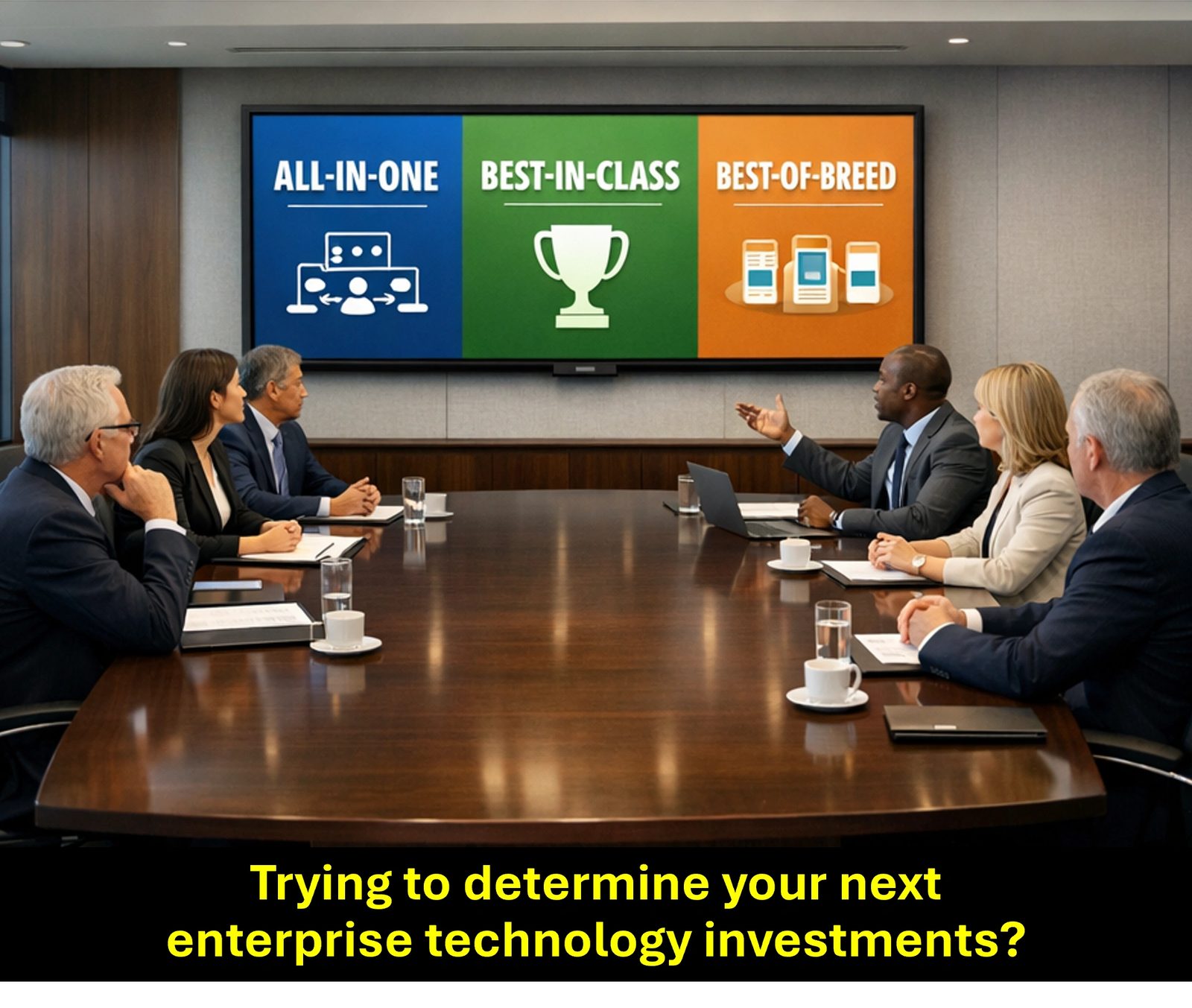
Enterprise IT Solutions - Clients want better ways to achieve profitability, enable strategies, & meet operational goals & objectives. Finding the right business & technology solutions is a significant effort. Decision-makers have a smörgåsbord of options to choose from: "all-in-one", "best-in-class", or "best-of-breed" solutions.
Software supporting the business differs significantly. The 3 primary classes are: best-of-breed, best-in-class, and all-in-one software. Knowing the differences between the software classes can save money.
Primary Classes of Enterprise Software / Platforms
The informed (right) choice can reduce purchasing & integrating the wrong solution for the business – there are numerous variables to consider. At a macro scale, the primary classes are:
- Best-of-breed: performs specialized functions better than a limited capacity within a specific specialization or industry niche; typically constrains integrating many systems. To avoid these roadblocks, many organizations are turning to a best-of-breed approach. In other words, they are implementing smaller-scale, agile solutions that aren't meant to be "jack-of-all-trades." Each solution focuses on a specific functional area, and companies can integrate them to create a fully optimized software system aligned with their business needs.
- Best-in-class: designed to perform exceptionally well within a single department or area of focus.
- All-in-one software: offering a full suite of products from a single source. However, the all-in-one isn't necessarily "core competency" - they're designed to address all functions equally well (or poorly). All-in-one is generally a better choice for early-stage companies that want an economical & streamlined solution for the enterprise IT infrastructure – a quick jack-of-all, master-of-none to handle a wide range of demands right from the get-go.
Many companies keep redundant applications around & fail to invest in migration or enterprise integration. One common failure in Mergers & Acquisitions (M&A) is executive leadership's unwillingness (and M&A advisors' failure) to drive cost optimization. Failure to address this can quickly turn a promising M&A into a costly mess – reinforcing why most M&A 'partner' consulting firms ignore the technology due diligence & leave it to post-merger integration (when they have moved on). Either way, the money spent to support this redundancy is a waste.
Rot from Within
Redundant applications, shadowIT, and shadowAI drain business & IT resources from value creation & waste money on licenses & technologies without delivering new business functionality. Maintaining data synchronization across multiple databases can be difficult, leading to wasted effort in data reconciliation or getting wrong answers, depending on the database queries.
Many suite vendors bundle modules associated with specific industries and sell them as industry-specific bundles – with bundled pricing being lower than the other methods because the vendor can provide volume purchasing discounts. With bundling, you may pay for things you never use or don't need. Additionally, suite modules may not meet all business requirements, requiring customization or manual workarounds. Suite modules are notoriously rigid, and customizations risk failing with future updates.
A Best-of-Breed system was initially built by choosing individual software for each business department's function/needs. These solutions are compelling for the job and cover all needed functionality at the departmental level, with departments retaining responsibility for their software. Quick implementation times occur due to little exchange of information between each module (and their data silo).
Best-in-Class ERP springboards from the Best-of-Breed principles search for the most robust solution for each part of your business. For example, Sage Intacct is an accounting solution – the only one preferred by the AICPA. However, most small- to medium-sized businesses – especially those that foresee rapid growth and development of the business model – need more than just financials, where the Best-of-Breed philosophy comes into play. The Sage Intacct team knows the software is excellent at financials. By that same logic, they know other developers are best at their solutions. So, part of their business model is high-quality integrations with many market leaders in their respective spaces, like Salesforce and Criterion.
Best-of-class software is a specially designed solution for a given product category - not a "suite" for business functions (exceptional performance within one department or business area). Specialized for an A/P, A/R, HR, ATS, or Payroll function, not all of the above functions.
An all-in-one software system is an IT solution that offers a full suite of applications and functions to handle all aspects of a business's operations, from payroll to security and monitoring - providing everything businesses need to complete and maintain their IT infrastructure. However, the main downside to adopting an all-in-one approach is that it is more vulnerable to security threats - a data breach in one part of an all-in-one system is, therefore, a breach of the system as a whole.
In these cases, all-in-one solutions are economical because they bundle all IT products in a single package, often costing less than acquiring piecemeal software products.
Finding a Solution
A variety of factors should influence your approach to finding software solutions.
Features and functionality -Consider these when searching for a best-of-breed, best-of-class, all-in-one solution.
Price - Understandably, one of the primary concerns for business owners looking to replace legacy IT systems is replacement cost; selecting s/w for each department (i.e., the best-of-breed approach) costs more because it requires purchasing multiple pieces from multiple vendors. Support services require specialized staffing, and maintenance fees can be steep for many products. In addition, implementation budgets & schedules are commonly exceeded.
Scalability - Software is scalable when it can support your organization's growth without substantial additional investment in licensing or infrastructure; it can adapt to changing circumstances & technological innovation over time. All-in-one solutions may lack the scalability to accommodate business growth over time.
Other Factors to Consider
Several other essential elements to consider before purchasing a new IT product for your business.
Regardless of which system approach you choose (i.e., best-of-breed vs. best-of-class vs. best-of-suite vs. all-in-one), you need to account for the following factors:
Integration complexity - IT infrastructure requires intricate integration capabilities to ensure bi-directional file sharing and streamlined workflows. Exporting data using best-of-breed or best-of-class software can present department roadblocks or slowdowns. All-in-one solutions make data synchronization more accessible by letting users share data in real time, which can speed up workflows and business processes.
Staffing - Integrating a new IT system requires significant IT resources. As the infrastructure accommodates more employees and users, more IT personnel may be required to maintain the system and perform troubleshooting and service requests.
Future Forward - With a best-of-breed approach, organizations must factor in a product's upgrade cycle; however, best-in-class & all-in-one solutions typically handle upgrades entirely on the vendor's side. Upgrades are an inevitable part of an IT product and should be considered so they don't disrupt workflows after purchase.
A best-of-breed solution might be ideal for a decentralized organization spread across several time zones and offices - large organizations can choose a vendor that appeals to specific needs without sharing the solution with teams elsewhere.
With an all-in-one solution, teams are forced to compromise on a solution acceptable to all offices and teams, whereas a best-of-breed lets offices or teams find the most value for them.
Costs of Efficiency
The convenience and efficiency of an all-in-one software product shouldn't be the only factor determining whether you adopt it. Efficiency comes with a slate of costs that can offset whatever gains the organization can benefit from with an all-in-one IT infrastructure.
Conclusion
To summarize, here are the main drawbacks of all-in-one software systems.
These issues are common among all-in-one and best-of-suite software systems and should give pause to anyone considering adopting these systems:
- Massive financial and operational commitment to a new system
- Gutting and replacing an entire tech stack with a new suite takes time and expertise
- Faith in the long-term viability of the new technology (i.e., 5, 10, or 15 years)
- Third-party integrations and APIs may not be supported
- Implementation and maintenance costs may exceed any perceived convenience benefits
- Businesses slated for significant long-term growth may want to think twice before investing in a system-wide all-in-one IT solution.
- Picking a best-of-breed or best-in-class product reduces the likelihood of replacing the entire infrastructure later.
ABOUT
DGCpartners LLC is an independent, technology-agnostic management and information technology consulting firm founded in 2013. The firm functions as a Veteran-Owned Small Business (VOSB) and is headquartered in Dresden, Maine, USA.
Core Services
The firm deploys experienced managers with Big 4 consulting backgrounds to provide tailored business-IT frameworks. Their core focus includes:
- Program & Project Management: Establishing project management offices (PMO) and orchestrating multi-project organizational transformations.
- IT Governance & Strategy: Aligning technology investments directly with business goals using frameworks like ITIL, COBIT, and ISO.
- Business Resiliency & Continuity: Structuring crisis management, emergency preparedness, and operational recovery systems.
- Project Rescues & Turnarounds: Stepping into failing or off-track high-stakes technology investments to stabilize delivery and optimize IT operations.
- Interim & Fractional Leadership: Providing placeholder executive support for organizational leadership voids.
Client Base
The firm provides professional services to larger consulting firms, MSPs, government entities (DGC holds active federal registration), and Fortune 500 companies. We support distinct market segments including financial services, aerospace & defense, healthcare, and manufacturing.
🌐 dgcpartners.com 📱 +1 207.751.0218 📧 info@dgcpartners.com