
How Small Businesses Can Manage Rapid Growth and Keep Control
DGCpartners · · 6 min read
For small business owners riding rapid business growth, the excitement often comes with a tight chest: more customers, more decisions, and less room for error. Scaling challenges can show up overnight as quality slips, communication frays, and the team's energy gets stretched thin. The effects of business expansion are real: systems that once felt simple begin to leak time, money, and trust. With steady, grounded growth management strategies, growth can remain something a business controls rather than something that controls it.
Quick Summary: Staying Grounded During Fast Growth
- Use a growth assessment checklist to spot pressure points early and choose your next best move.
- Regularly update financial forecasts to protect cash flow and stay ahead of new costs.
- Automate repeatable processes to reduce overwhelm and keep quality steady as demand rises.
- Hire strategically to strengthen key roles without stretching culture, clarity, or budgets.
- Optimize supply chains and refine marketing strategy development to meet demand without losing focus.
Build a Growth-Ready Plan Without Losing Control
Here is how to move from intent to control.
This process helps you grow on purpose by assessing whether your operations, people, and decision-making habits can handle increased demand. It matters because rapid growth can be both exciting and draining, and a simple, repeatable check-in helps keep your business steady as you expand.
Step 1: Map your infrastructure and pressure points Start with a one-page "growth map" of how work flows today, from lead to delivery to getting paid, and note where delays, errors, or customer complaints show up. Add your current capacity limits for the essentials: time, cash, tools, and systems. Treat this as a calm snapshot, not a critique, so you can see what needs support before you add more volume.
Step 2: Audit resources and reallocate to what drives delivery List your top 3 growth goals for the next 90 days, then match each goal to the people-hours, budget, and tools it truly requires. Use the identify resource requirements checklist approach: write what must be true to achieve each goal, then reallocate money and attention away from "nice-to-haves." This keeps growth from becoming a scatter of urgent tasks that exhaust everyone.
Step 3: Run a team capability check to spot leadership gaps Write down your key responsibilities and decide who owns each one: quality, scheduling, customer communication, training, and problem-solving. Then ask, "Where do decisions get stuck, and who is overloaded?" Naming gaps early lets you design support, through training, a new role, or a simpler hand-off, before bottlenecks become burnout.
Step 4: Remove one bottleneck with a simple hand-off rule Choose the single point where work most often slows down and create a clear "definition of done" for that step. Add one hand-off rule, such as "No work moves forward without X checked" or "All requests enter through one intake channel." Small rules reduce chaos and protect focus, which is essential when demand rises.
Step 5: Strengthen scaling decisions with structured learning Pick one core management skill to build this month, such as delegation, hiring basics, cash planning, or process improvement, and schedule one learning block each week. You may check this online education option for a structured overview of business fundamentals. Anchor learning to real decisions you face by keeping a short decision log: what you chose, why, and what happened. This turns growth into a steady practice of better judgment, not a constant fire drill.
You do not need perfect systems, just a steady rhythm of clear checks and calmer decisions.
Plan → Align → Build → Stabilize
This rhythm turns growth phase management into something you can repeat, not reinvent. It helps you streamline operational workflows, set hiring priorities, and time technology investment so you stay calm, clear, and responsive as demand rises.
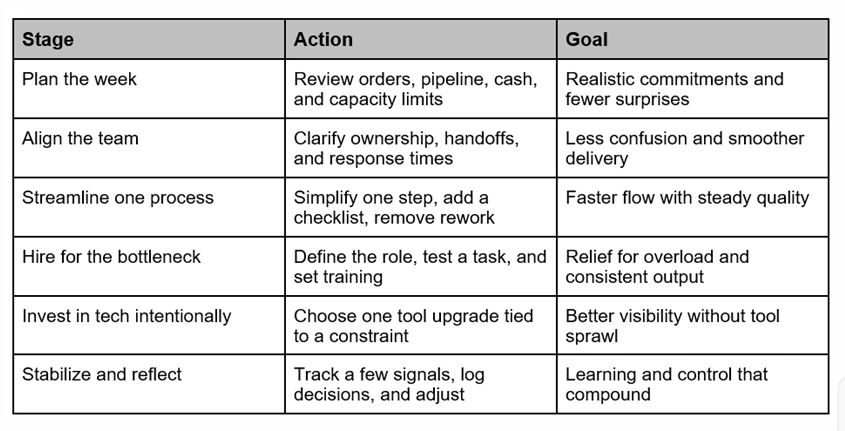
Move through the stages in order, then loop back weekly. Each pass tightens scalability planning by turning pressure into practical adjustments, so improvement becomes a steady habit rather than an emergency response.
Start with one cycle and let consistency earn your confidence.
Protect Demand: Tighten Supply and Market With Intention
Rapid growth can feel nourishing until it starts draining your time, cash, and focus. These growth sustainability tactics help you protect demand by stabilizing supply chain optimization and choosing scalable marketing campaigns that attract the right customers.
1. Set "calm thresholds" for inventory: Pick 3–5 top-selling items and define clear reorder points (example: "reorder when we hit 14 days of stock"). This makes inventory management less emotional and more repeatable during the "Stabilize" phase. Keep a simple weekly dashboard: on-hand units, days of cover, supplier lead time, and stock-out incidents.
2. Shorten your forecasting horizon and review it weekly: Instead of trying to predict the whole quarter, build a 2–4 week customer demand forecasting rhythm you can adjust quickly. The most useful habit is to shorten forecasting horizons so your forecast stays flexible when growth surges. Start with one spreadsheet tab: last 8 weeks of sales, planned promos, expected capacity, and a "confidence score" (high/medium/low).
3. Align marketing volume with fulfillment capacity: Before you push a campaign, decide what you can actually deliver: orders per day, service slots per week, or units shipped per week. Then put a "capacity cap" on your promotion: limit a discount to the first 100 orders, schedule ads to run only on days you can fulfill, or promote a wait-list when you are near the ceiling. This is how "Plan → Align" protects your reputation while you grow.
4. Segment your audience so you attract the right demand: Use target audience segmentation to separate people who buy repeatedly from people who buy once and disappear. Create 2–3 segments you can act on today: "high-margin repeat buyers," "local pickup customers," and "price-sensitive deal seekers." Aim your scalable marketing campaigns at segments that align with your supply reality (for example, promote bundles to repeat buyers when shipping capacity is tight).
5. Build a simple "A/B assortment" for supply resilience: Create an A-list of core products you will keep in stock no matter what, and a B-list of optional items you sell only when supply is smooth. When a supplier slips or demand spikes, you can pause B-list items, shift marketing to A-list, and keep your customer experience steady. This reduces chaos without requiring a full system overhaul.
6. Treat automation as a stress-reduction tool, not a big leap: If you are ready to "Build," start by automating one constraint at a time: reorder alerts, low-stock reports, or basic warehouse pick lists. Some teams using AI in supply chain optimization report a 20–30 percent reduction in inventory. Still, you do not need to start there; begin with one workflow that removes a weekly headache.
When supply and marketing move in sync, growth feels steadier: fewer emergencies, better margins, and more predictable delivery. Choose two ideas that would at once reduce pressure in your week and commit to running them consistently for the next 30 days.
Commit to Two Steady Moves That Keep Growth Manageable
Rapid growth can feel like being pulled forward by demand while control slips through the cracks. The steadier path is a simple mindset: strengthen the foundations first, then grow intentionally, so your operations, pricing, and marketing align with the capacity you can truly support. This business growth summary comes down to reinforcing key strategies that turn growth management challenges into clear choices, not constant fires. Scale what you can sustain and let your systems lead the pace. Choose your next two growth moves and commit to them for the next 30 days, checking progress weekly. That is owner empowerment in practice, building scaling confidence and a business that stays resilient, healthy, and profitable as it expands.
Discover how DGCpartners can empower your team with sustainable, technology-agnostic solutions for long-term success by visiting DGCpartners today!